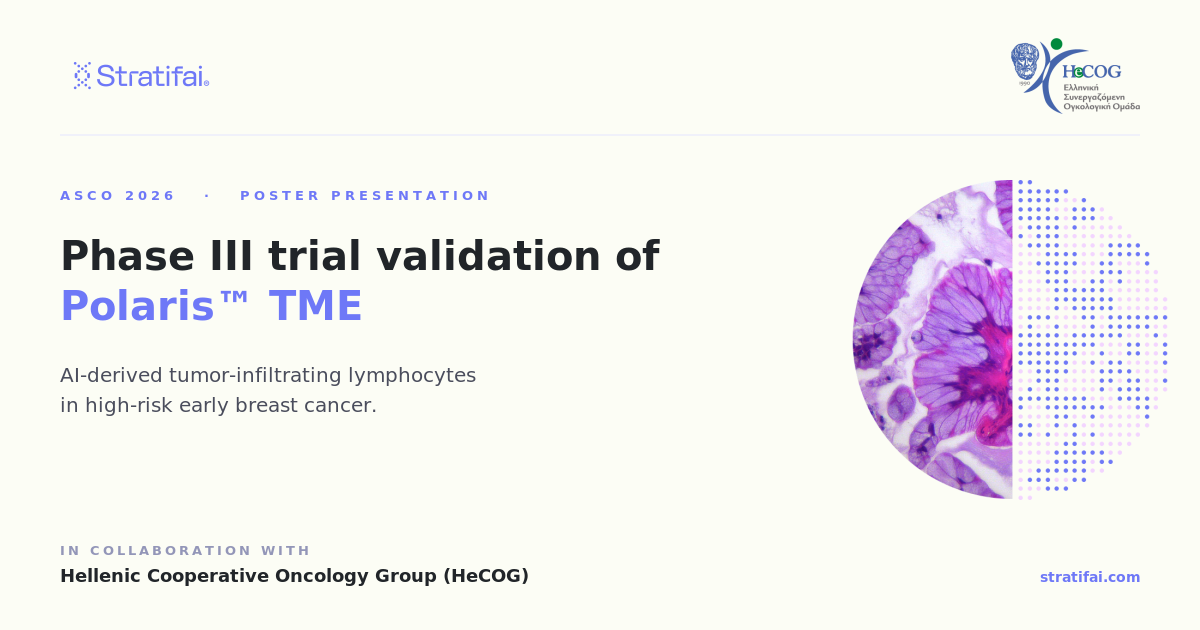
Berlin, Germany, and Athens, Greece, May 2026. StratifAI, the AI biomarker company for precision oncology, today announced results from a prospective-retrospective Phase III validation of Polaris™ TME, its AI biomarker for the quantification of tumor-infiltrating lymphocytes (TILs) from hematoxylin and eosin (H&E)-stained whole-slide images. The study, conducted in collaboration with the Hellenic Cooperative Oncology Group (HeCOG), will be presented at the 2026 American Society of Clinical Oncology (ASCO) Annual Meeting in Chicago.
Quantifying TILs at scale
Tumor-infiltrating lymphocytes are an established prognostic and predictive biomarker in early breast cancer. Today, TILs scoring is performed manually by pathologists, a process that introduces interobserver variability and limits throughput at scale. Polaris™ TME applies deep learning to digitized H&E slides to quantify TILs in a standardized, reproducible way, opening a path to AI-derived biomarkers in routine clinical workflows. The model is built on StratifAI's Polaris™ foundation model for computational pathology and is designed for end-to-end deployment from whole-slide image to clinically meaningful readout.
A four-trial, 1,214-patient validation across all breast cancer subtypes
The validation analyzed 1,214 patients with high-risk early breast cancer, treated with adjuvant contemporary dose-dense chemotherapy and enrolled across four HeCOG trials conducted between 1997 and 2008 (three randomized and one observational). All histological subtypes were included: hormone receptor-positive/HER2-negative (63%), HER2-positive (32%), and triple-negative (14%). Median follow-up was 116 months. Manual TILs scoring had been performed centrally by pathologists following International TILs Working Group guidelines, providing a robust ground truth against which Polaris™ TME was evaluated.
High concordance with pathologists, prognostic in HER2-positive and TNBC
When deployed blindly on the external HeCOG cohorts, Polaris™ TME showed strong correlation with manual TILs scoring (Spearman ρ = 0.60, p < 0.001) and high discrimination performance at clinically relevant thresholds, with an area under the curve (AUC) of 0.92 for high-TIL classification (greater than 50%) and 0.78 for the 5% threshold.
The model was also prognostic for long-term outcomes. In triple-negative breast cancer, patients with predicted low TILs had significantly lower 10-year invasive disease-free survival than those with predicted high TILs (55.1% versus 70.9%, p = 0.034). A consistent pattern was observed in HER2-positive disease (55.3% versus 64.8%, p = 0.096). No survival differences were observed in luminal cancers.
Toward AI biomarkers in routine breast cancer care
These results support Polaris™ TME as an accurate and reproducible alternative to manual TILs scoring, and provide evidence of its prognostic value in the subtypes where TILs carry the strongest clinical signal. Prospective validation and harmonization efforts are warranted to support implementation in routine pathology workflows and prospective interventional trials.
Presented at ASCO 2026
The full results will be presented as a poster at the 2026 ASCO Annual Meeting:
Poster #42 — Breast Cancer (Local / Regional / Adjuvant)
Monday, June 1, 2026, 1:30 to 4:30 PM CDT
McCormick Place Convention Center, Chicago, IL
Abstract #557 (J Clin Oncol 44, 2026, suppl 16)
Dr. Elena Fountzilas (HeCOG, Athens, Greece) will present on behalf of the study team.